I’ve been meaning to set up some kind of automated horticulture system to grow herbs and vegetables for a while. The primary motivation hasn’t been the fruit of my labor, as much as it has been to experiment with – and to learn how to use – sensors, actuators, and microcontrollers. Progress has been slow; I usually only get time to work on it on weekends, and I’ve made several mistakes on the way. The project also revealed many problems with sensors that aren’t typically documented, but have to be solved anyway.
Planter Boxes
I didn’t want to buy planter boxes specifically for this project, because a) they can be expensive, and b) the sizes weren’t to my liking. So I went ahead and bought a few old wine crates off Craigslist and reinforced them with corner brackets (Figure 1). I’ve also drilled holes at the bottom for drainage.

Figure 1: Wine Crates with Corner Braces

Figure 2: Varnished Wine Crates
I also read online that wine crates are typically made of pine wood, and prolonged exposure to moisture can cause it to rot or crack. Most resource suggest that they be varnished with some kind of oil, however, the linseed oil typically available is not considered safe since it will leach chemicals into the soil. OK for flowers, not OK for something that one will perhaps consume! So I varnished the boxes with tung oil, diluted 50-50 with citrus solvent (Figure 2). Also learned the hard way that
- styrofoam is soluble in citrus solvent (apparently Sony filed a patent to use citrus as a means to dispose of styrofoam packaging), so after a point I just had tung oil dripping all over the garage floor; and
- letting the varnish dry in direct sunlight causes some form of crystallization which gives the wood a rough exterior
Piping
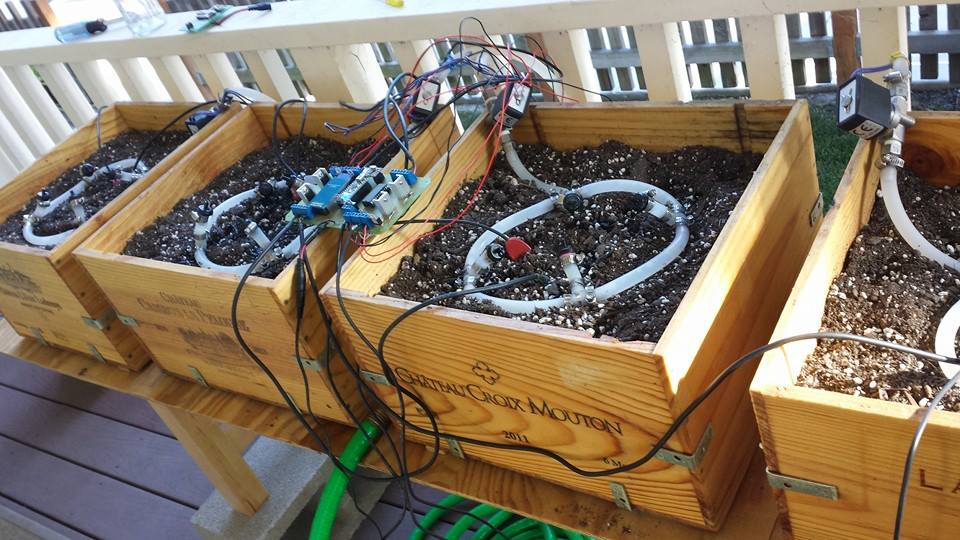
Figure 3: Finished Planter Boxes
The finished boxes with soil and pipes is shown in Figure 3. Due to the variety of standards I needed
- a female Garden Hose Thread (GHT) to 3/4″ Male National Pipe Thread (NPT) / 1/2″ female NPT (external / internal)
- a 1/2″ male NPT to 1/4″ female NPT bushing
- a 1/4″ male NPT to 1/4″ internal diameter (ID) barb
In addition, I needed a backflow preventer and a 25 psi pressure regulator (the faucet output is at 60 psi). So that’s potentially 5 points where leaks can occur.
I had initially used some silicone tube that I had lying around but found that over time it inflated like a balloon and burst. Turns out that they’re rated at around 30psi, and at a sustained pressure of 25 psi, they eventually gave way. I had to replace the pipes with some braid reinforced silicone. I’ve tried to use silicone and stainless steel parts wherever possible.
 Prasenjit Sengupta, Ph.D.